i-Tree Eco
Looking to download i-Tree Eco? Click here.
i-Tree Eco v6 overview
i-Tree Eco version 6 is a flexible software application designed to use data collected in the field from single trees, complete inventories, or randomly located plots throughout a study area along with local hourly air pollution and meteorological data to quantify forest structure, environmental effects, and value to communities. Learn more
- Download the i-Tree Tools Suite for Windows (Windows applications and links to all web tools)
- System Requirements for Windows installations and information for Mac operating system
- Help for IT Departments
- Current i-Tree Version and Change Log
What does Eco provide?
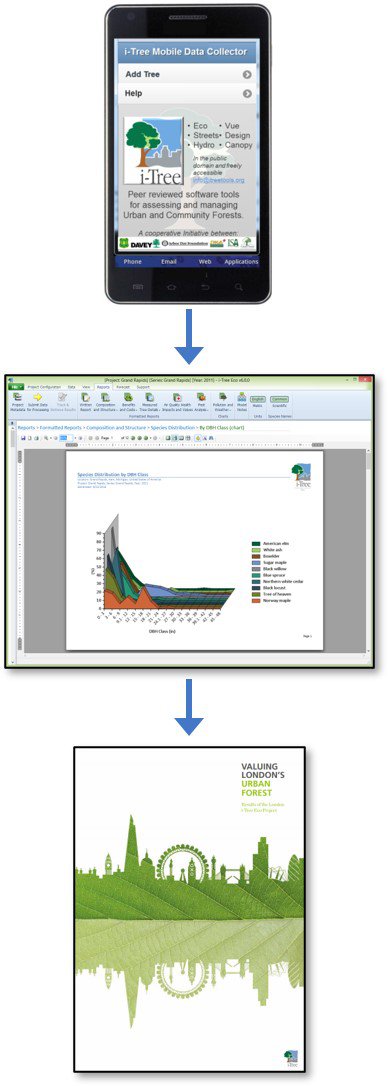
i-Tree Eco provides extensive forest and individual tree analyses including the following:
Ecosystem services:
- Pollution removal and human health impacts
- Carbon sequestration and storage
- Hydrology effects (avoided run-off, interception, transpiration)
- Building energy effects
- Tree bio-emissions
- Avian habitat suitability (plot-based projects; limited to 9 bird species) Avian Habitat Suitability Report Example
- Ultraviolet radiation (UV) tree effects UV Report Example
Structure and composition analyses:
- Species condition and distribution
- Leaf area and biomass
- Species importance values
- Diversity indices and relative performance
Forecasting modeling options including:
- Tree planting inputs
- Extreme event impacts for weather and pests
- Annual mortality adjustments
Management information including:
- Pest risk analysis
- User defined optional fields
- Cost benefit analysis
Eco Report Examples - Springfield MA Squares
These are examples of exported structural, benefit analyses, individual level PDF reports from a demonstration project applying Eco to (2) small public squares. You will not need Eco installed to view examples of these reports.
- Springfield Square report examples: Springfield Eco zip file package (6.3mb)
Who is using Eco?
Thousands of people in the United States and internationally have used Eco for projects ranging from small tree inventories to regional scale assessments. Eco users include government agencies, consultants, nonprofits, universities, researchers, volunteers, educators, advocates and more.
Choose your project type
Complete Inventory - Typically used for smaller public areas or private properties such as corporate campuses, parks, apartment complexes, individual homes or cemeteries. Learn more
Sample Inventory - Used when the study area is too large to cost-effectively inventory the entire tree population. Project estimates and benefits are based on sampling of random plots. Learn more
Learning resources
Manuals and Guides - Provide step-by-step instructions for all project phases. New guides offer detailed information on specific topics. Learn more
Video Learning - New instructional videos are being developed to show you how to use the Eco v6 application. Learn more
Model Methods, Technical Papers and Journal Articles - Explain the background model science, processes and limitations. Learn more
FAQS-Frequently Asked Questions Posted on our i-Tree User Forums. Learn More
International Eco users
Adapted for Canada, Australia, the United Kingdom, Mexico, Europe, Colombia, South Korea, Japan and New Zealand. Eco v6 has been adapted for use throughout multiple partner countries with pre-processed hourly pollution and weather data available in the Eco application.
Processing for other international Eco users - i-Tree Eco v6 can be used in all other countries, outside of partner countries mentioned above, but will require use of the i-Tree Database system. This online portal was developed to accommodate growing international interest in Eco and provides a automated process for users to submit new international city location information, hourly pollution data, and hourly precipitation data to be validated and later incorporated in future version of Eco.
Individual Global Cities available - Many international users have used this process and numerous global cities are now available for all to use in Eco. See the list of Other International Cities to view which cites and data are available in Eco. Some global cities may only have a location and limited pollution or precipitation data, which will limit some Eco reports availability for an individual city. Learn more about international options
Eco v5
Eco v5 is no longer a supported part of the i-Tree Suite and is not available in the recent version. Therefore, you may want to export reports from an existing Eco v5 project before updating the i-Tree software. Version 5 projects can be opened in Eco v6 and automatically updated. Updated projects will require reprocessing for reports to be generated using the latest models. Learn more about this.
Acknowledgements
Learn more about the many people who have contributed to the development of the i-Tree Eco model and assisted in adapting international versions. Learn more