i-Tree Streets (legacy)
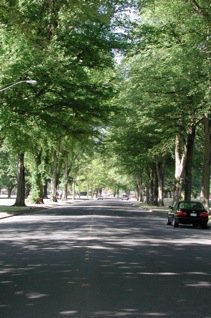
Within the i-Tree software suite, street tree populations are assessed using i-Tree Streets, which is an analysis tool for urban forest managers that uses tree inventory data to quantify the dollar value of annual environmental and aesthetic benefits: energy conservation, air quality improvement, CO2 reduction, stormwater control, and property value increase.
It's an easy-to-use, computer-based program that allows any community to conduct and analyze a street tree inventory. Baseline data can be used to effectively manage the resource, develop policy and set priorities. Using a sample or an existing inventory of street trees, this software allows managers to evaluate current benefits, costs, and management needs. More information can be found here.
Learn more
Initial Decisions
Important: As a legacy application, the i-Tree Streets tool no longer receives support with respect to tree benefits science updates and operating system compatibility. i-Tree Eco v6 offers the latest science and user enhancements for tree canopy inventories and benefits assessments, with certain exceptions around street segments and empty tree pits. Learn more about using Eco for your project here.
The first steps in creating a Streets project are:
- Define the street tree population for the project you wish to conduct. The population can range from a single planting site on a block of interest to a particular neighborhood, but it is more commonly the entire city street tree population. Users have the option of analyzing an existing street tree inventory or completing a new Streets-compatible inventory.
- If an existing street tree inventory is not available, users must decide whether a complete or sample inventory of their community's street trees will be conducted. A complete inventory provides a much more comprehensive picture of your urban forest and a great foundation for daily work activities as well as future planning. A sample inventory, on the other hand, is quicker, less expensive, and can provide baseline data for decision making, but typically cannot be used for day-to-day management activities. You should balance the needs and resources of your community to decide which inventory method is appropriate.
Working with Existing Inventories
Whether you have a small or large population of street trees, setting up a Streets project with an existing complete inventory is relatively straight forward. Streets is not GIS-based and requires only basic inventory data. Designed to be flexible and adaptive, Streets can accept and analyze data from any existing street tree inventory provided species and trunk diameter data are present and that Streets inventory formatting protocols are correctly followed.
A (3) part instructional video series on the Streets import process can be accessed from the Video Learning page. Additonal resources and guides can also be found on the Resources- Archives page under the Streets Existing Inventory Import Resources tab
Complete Inventory Projects
For communities without an inventory, Streets data collection protocols can be used as a guideline for data collection using any means, including other systems, the integrated PDA or mobile web form utilities or paper and pencil. This would be a new, complete inventory.
Sample Inventory Projects
Sample inventory projects for i-Tree Streets are typically conducted in cities where a complete street tree inventory is not feasible due to limited resources. Street tree sampling provides a cost-effective means to capture a snapshot of the resource structure, how it functions, its value, and management needs. Where sampling is an option, it can be used as a starting point for municipal tree planning and management by providing the necessary information for decision making.
Getting Started
Detailed specifications on setting up a project and carrying out field data collection can be found in the Streets Manual. Persons considering their own Streets projects should be aware that the program requires specific types and amounts of data to accurately project the structure, function, value and management needs of the street tree resource. The validity of results from Streets, in part, will depend on how closely the user adheres to project setup and data collection protocols.
Acknowledgements
i-Tree Streets is an adaptation of the Street Tree Resource Assessment Tool for Urban forest Managers (STRATUM), which was developed by a team of researchers at the USDA Forest Service, PSW Research Station. The STRATUM application was conceived and developed by Greg McPherson, Scott Maco, and Jim Simpson. James Ho conducted original STRATUM programming. The numerical models utilized by STRATUM to calculate tree benefit data are based on years of research by Drs. McPherson, Simpson, and Qingfu Xiao (UC Davis). Reference city data on tree growth and geographic variables were developed under the direction of Paula Peper, Kelaine Vargas and Shelley Gardner. Integrated elements of the Mobile Community Tree Inventory application are credited to David Bloniarz (USFS, NRS), Robert Sacks (Bluejay Software), H. Dennis Ryan (University of Massachusetts, Amherst), and Michael O'Loughlin (City of Springfield, Massachusetts). Revisions for i-Tree Streets versions were carried out by members of The Davey Institute, including Scott Maco, David Ellingsworth, Megan Kerr, Lianghu Tian and Al Zelaya based on newly available research from PSW and feedback from i-Tree users.